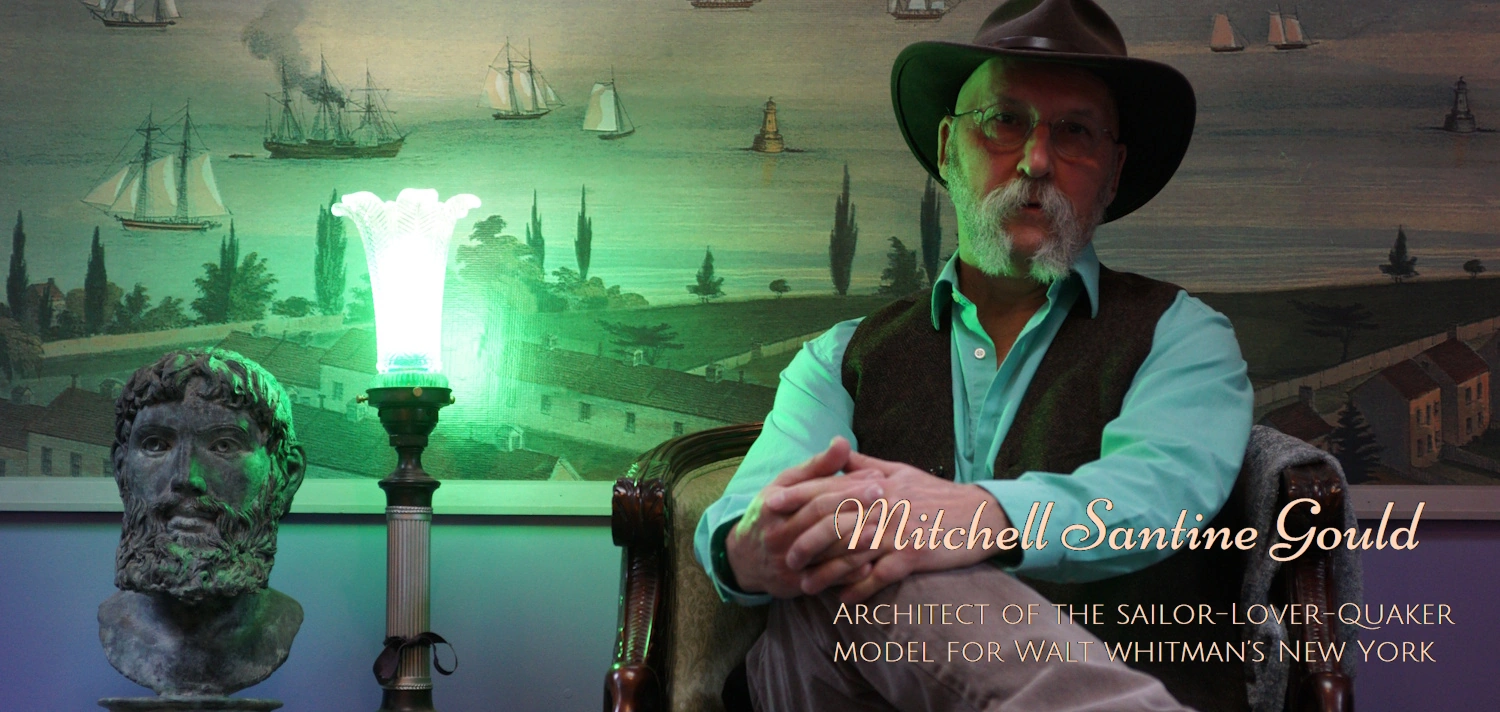
Mitchell Santine Gould
In 2026, public historian Mitchell Santine Gould began publishing his literary trilogy, Kelson of the Creation. The project serves as the narrative culmination of his decades of archival research, dramatizing Walt Whitman’s role as the spiritual heir of Elias Hicks and the de facto spokesbard for the Sailors, Lovers, and Quakers who made 19th-century New York not only a premier international seaport, but the foremost crucible of American tolerance.
Mitch is recognized as a leading authority on Walt Whitman’s profound and mysterious connection to Quakerism. He coined the term “Walt Whitman’s Quaker Paradox” to define a historical puzzle that quietly occupied the heart of Whitman scholarship for a century: reconciling America’s most eloquent voice for sexual self-determination with a religious society that had famously retreated behind a “fence” of strict prohibitions against art, theater, and music.
His research traces how the reception of Inner Light morality filtered into secular American culture. This evolution accelerated during the final years of Elias Hicks, when radical reformers like Frances Wright restated Hicks’s positions on individual conscience to defend the fundamental right to sexual choice. The radical wing of the Free Love movement later adopted Wright’s appeal to the “God within” as a core plank of their sociopolitical platform. Extending the insights of Quaker historian Frederick B. Tolles, Mitch demonstrates how Ralph Waldo Emerson further catalyzed this transformation by recasting Inner Light theology as the psychological framework for “Self-Reliance.”
This deep dive into the 19th-century Quaker experience illuminates a historic transition. By 1860, contemporary Friends accounted for their declining attendance by noting that secular society had integrated their core testimonies, observing that “the world has become, in a measure, quakerised, and that, therefore, one may entertain Quaker principles and not belong to the Quaker church.”
Mitch’s peer-reviewed findings have appeared in Quaker History and Quaker Theology. His work is also featured in Walt Whitman: An Encyclopedia, The Gay & Lesbian Review Worldwide, The Friend (London), and the historic volume Gay, Lesbian, Bisexual, and Transgender Events.
Beyond the page, Mitch was the primary donor behind the historic exhibition Toward a Quaker View of Sex at the LGBTQ Religious Archives Network. He has led intensive workshops on Whitman for both academic and community groups, and in 2006, wrote and performed “I Call to Mankind” — an hour-long solo play dramatizing “Song of Myself” — for audiences across the Pacific Northwest.