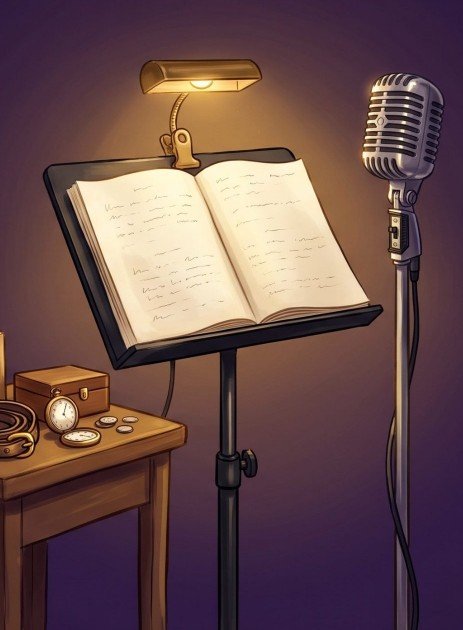
Distance and Voice: Staging with Your Ears
Step in to whisper, step back to shout, turn away to mutter
On a regular stage, actors project their voices out to the back row. In front of a microphone, that habit shatters the illusion. A microphone isn’t an audience in a big hall; it’s the listener’s ear, inches away.
In a play for voices, you can’t use scenery to show where people are or how far apart they stand. You show it with sound: how close each actor is to the microphone, how loudly they speak, and which way they face. Each move an actor makes changes how intimate or how powerful a line sounds, without changing a single word.
Distance, in other words, takes the place of scenery. And who stands closest to the microphone usually sounds like the one in charge.
Real microphones or props? Some readings use working microphones that record or amplify the voices. Others, like our reading of The Light in Washington, use non-working microphones as props, for the old-time radio look, and record the performance on a phone placed in the room. The rules below work either way. With prop microphones, the actor’s distance from the audience and from the recording phone does the same job.
Four Distances: How Close Is the Speaker?
Every line falls into one of four zones:
-
Very close (two to four inches):
Hushed, secretive, right in your ear. Up close, a voice picks up a warm, deep tone and loses the echo of the room. Save this distance for private thoughts, confessions, or a threat whispered face to face.
-
Talking distance (six to twelve inches):
The normal, neutral setting: two people across a kitchen table or side by side in a carriage. It sounds like ordinary conversation.
-
Across the room (three to six feet):
The echo of the room starts to surround the voice. It suggests a large parlor, a drafty hall, or someone hanging back. A speaker at this distance sounds less in command than whoever is closest to the microphone.
-
Far away (eight feet or more):
The voice struggles against the space: a shout from a courtyard, a challenge through a barred window, someone calling from the stable. Always pair it with a character close to the microphone who reacts, so the audience can tell where everyone is.
Which Way the Actor Faces: Directness and Command
Distance tells listeners how far away someone is. Which way they face tells listeners where their attention is:
Putting It to Work: Novel Habits and Stage Fixes
Turn descriptions into movements the actors can make:
| What the Scene Needs | The Novelist’s Habit | What to Do Instead |
|---|---|---|
| Shouting indoors | A furious outburst written as if it’s delivered right into the listener’s face. | Step back to shout. Have the actor step about three feet back before shouting, so the sound doesn’t distort or blast the audience. |
| A big space | Describing wide hallways, high ceilings, and sprawling parlors. | Let the room’s echo do it. Move the actor a few feet back, so the echo of the room suggests the size of the space. |
| A secret | Tags like “he murmured under his breath.” | Close the gap. Bring the actor within a couple of inches of the microphone and let the closeness carry the secret. |
| Rapid back-and-forth | Constant overlapping talk among several people sharing one microphone. | Space out the lines. Leave enough room between lines for actors to trade places at the stand without bumping into each other. |