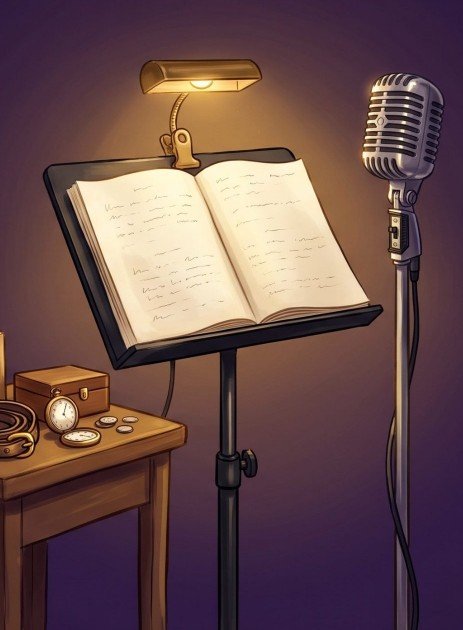
The Plan and the Schedule: One Room, One Session, One Performance
How the reading of The Light in Washington is set up, minute by minute
This is the plan for our reading of The Light in Washington, which hasn’t happened yet. After the performance, we’ll update this page with what actually happened — what worked, what didn’t, and what it really cost.
This guide doesn’t cover producing the next Our Town or Death of a Salesman. A full production has too many moving parts and too many costs. The plan here is much smaller, and it works: a closed working session with a director and actors, followed by a single performance for a small invited audience — all in one afternoon or evening, in one rented room.
Below is the actual plan for the reading of my play, The Light in Washington. Use it as a model and change the details to fit your own story.
The Play and the Event
| The play | The Light in Washington, a short live radio play, 25 to 30 minutes long |
|---|---|
| Setting | Brooklyn and Washington, D.C., December 1868 |
| Three acts, played without a break | Act I: The Parlor (Brooklyn) Act II: The Journey and Arrival (from the Washington depot to 15th Street) Act III: The Turnaround at 15th Street |
| Style | Old-time radio, performed live: scripts on music stands, prop microphones, and sound effects made by hand |
| What happens | A closed working session with the director and cast, then one uninterrupted performance for a small circle of guests |
| Guests | A small group, invited by the director |
| Date and place | A rented studio in Portland; the date will be set with the director |
| The goal | To tune the pacing of the dialog, the contrast between voices, and the timing of the sound effects — then hear the whole play straight through, in front of listeners |
| Recording | The playwright records the performance on his phone, for private study only. Each performer signs a short release that promises the recording won’t be released or posted without that performer’s written consent. |
The Cast: Six Actors
The play needs four men, one woman, and one actor of any gender (for the boy, Freddie).
| Part | Voice | Other Duties |
|---|---|---|
| 1. Walt Whitman Man, playing 49 |
A high, husky baritone; warm, unhurried, and conversational — think of the rock singer Bob Seger talking, not an orator. He carries the emotional climax. | None |
| 2. Fred Vaughan Man, playing 30 |
Tenor. A working-man philosopher carrying grief and lost youth, but holding on to hope. Ideally a Canadian-Irish lilt; any honest, unforced working man’s voice will do. | None |
| 3. Freddie Vaughan Any gender, playing 6 |
A clear, nimble child’s voice — a young actor, or an adult who specializes in children’s voices. Innocent and spirited; delivers misheard grown-up phrases in complete earnest. Ideally echoes his father’s lilt; no accent is fine. | None. If the actor is under 18, a parent or guardian signs the release and approves the length of the session. |
| 4. Peter Doyle Man, playing 25 |
Warm and lyrical, with easy humor and confidence. Cast to contrast with Fred in pitch and pace, so listeners can tell them apart. Ideally a mix of Southern and Irish (Richmond by way of Limerick); any warm, easy voice will do. | Reads the stage directions in Act I. Also voices the depot ticket agent and the street voices. (Not the policeman, who shares Peter’s scene in Act III.) |
| 5. Frances Vaughan Woman, playing 22 |
A middle-class Brooklyn woman with a touch of Victorian polish; warm, loving, and harried. | At a stand for Act I; then reads the stage directions and helps with sound effects in Acts II and III. |
| 6. Policeman Man, any age |
A brusque, officious Washington patrolman — more puzzled than menacing. A small speaking part in Act III. | Makes the sound effects for the whole play. |
The Schedule: Two and a Half Hours with the Cast
We reserve the room for three hours. The cast is called for two and a half; the extra half hour is for setting up beforehand and packing up afterward. With paid professionals on a tight clock, every minute is planned, so that the actors are at their best for the performance.
| Time | What Happens | Details |
|---|---|---|
| 0:00 – 0:45 | Read-through around the table | The director leads a first reading of the whole script. Accents and pacing are adjusted, and the director gives notes on each character. |
| 0:45 – 1:15 | Sound-effects rehearsal | Run Acts II and III with all the sound effects, skipping ahead from cue to cue and stopping only to fix a cue. Touch on Act I if time allows. Work out where Frances and the policeman move and when they make each sound. Test where to place the phone for the recording. |
| 1:15 – 1:35 | Break; guests arrive | The actors rest their voices. Quick sound check. Guests are seated. The phone is switched to airplane mode and ready to record. |
| 1:35 – 2:10 | Welcome and performance | The playwright introduces the play (about three minutes). Then the actors perform the whole play straight through, without stopping. |
| 2:10 – 2:30 | Talk-it-over | A private conversation among the director, playwright, and cast about what worked and what didn’t. Then everyone is paid. |
What You Come Away With
This plan leads to a modest investment and a modest result: one recording of your play, for your own use in revising it. As it stands, the recording can’t be shared with the public. You can buy the right to broadcast or sell the actors’ performances, but the fees and contracts for that are beyond the scope of this guide. If that’s your goal, you must work out broadcast rights, releases, and pay with your cast and director from the start.
What the reading does give you is proof that your story works aloud. It shows you what still needs polishing. It gives you something real to show theater companies that might be impressed enough to give your story a full run. And when an audience is moved by a tight, live version of your story, many will want to find the rest of it in your books.
Checklist: Before You Send Your Proposal to a Director or a Venue
- Sound cues match the props. Every sound effect in the script has a matching object on the sound-effects list.
- The play fits the clock. A 25-to-30-minute play fits inside the schedule above, with time to set up, read through, rehearse the sound effects, rest, perform, talk it over, and pack up.
- The release is clear. The performer release says the phone recording is for your private study only and won’t be shared without each performer’s written consent.
- The numbers agree everywhere. The number of actors (six, including the one who makes the sound effects), the length of the session, and the pay are the same in your cover letter, your room request, and your budget.