The Screenplay Trap: Why Novelists Should Write Audio Plays Instead
A Dramatist’s Case for the “Play for Voices”
Almost every novelist harbors a cinematic daydream. When the final chapter is locked and the prose cools on the page, the imagination naturally drifts toward the wide screen: the sweeping establishing shot, the festival premiere, the elusive Hollywood option.
It’s an understandable instinct, but for most writers of serious fiction, the screenplay is an artistic and practical cul-de-sac.
We are taught to treat cinema as the apex predator of dramatic storytelling. Yet the moment a novelist attempts to adapt prose for the screen, they discover that film does not translate the core strengths of fiction — it squanders them. The true heir to the novel isn’t the motion picture. It’s the audio play: the Theater of the Mind.
The Screenplay Trap: Blueprints vs. Literature
If a novel is a finished work of art, then a screenplay is an architectural blueprint.
When you write a film script, you are not communicating directly with an audience. You’re writing operating instructions for a small army of intermediaries: directors, cinematographers, location managers, and line producers. To serve this industrial machine, film demands a radical transformation, expressed in the industry dogma: Show, Don’t Tell.
For the novelist, this dogma is a trap.
Fiction derives its power from the soul — the private moral reckoning; the unspoken grief; the historical texture of thought; the friction between what a character feels and what the world allows them to say. On film, that inner landscape is routinely flattened into an actor staring blankly out a window while the camera does the heavy lifting. The writer’s voice — the very engine that gave the book its life — is systematically erased.
Furthermore, screenplays exist in an economic prison. An indie film script featuring two period-accurate streets, an authentic train car, or a crowd of forty witnesses is dead on arrival. Before a single frame is shot, the writer is forced to censor her imagination to satisfy a budget spreadsheet.
The Acoustic Canvas: Where Telling Is Showing
The audio drama — the “play for voices” — operates under an entirely different artistic contract. It doesn’t compete with cinema’s visual literalism; it leaps beyond it.
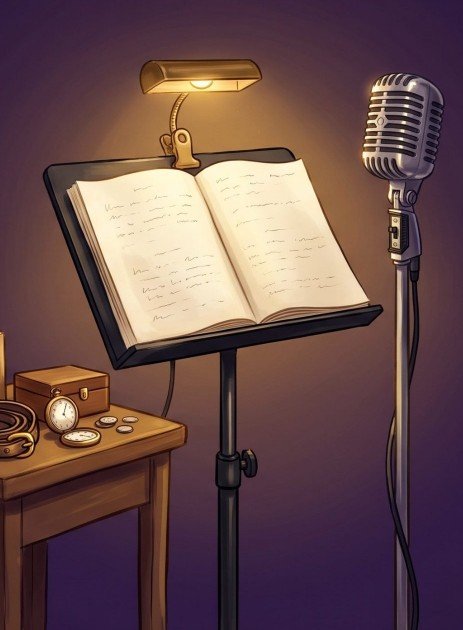
Picture an old-time radio show performed before a live audience. Actors stand at music stands and read from their scripts. Microphones — real ones or props — stand before them. Off to one side, someone makes the sound effects by hand: footsteps, a door, a horse’s hooves. The audience sees the actors, but the story happens in their ears and their imaginations.
In an audio play, the spoken word is not merely dialog; it’s landscape, atmosphere, and psychological action. Consider the artistic advantages this medium offers the fiction writer:
-
The Author’s Voice, Restored:
The audio play welcomes elevated, crafted diction. In modern film, naturalism reigns supreme, often reducing historical or poetic cadence to mumbled colloquialisms. In audio, the ear hungers for rhetorical rhythm, elegant sentences, and vocal variety. Language is restored to its rightful place as the primary engine of drama.
-
Limitless Production Value:
A sound cue costs nothing to imagine and virtually nothing to execute. A rainstorm rattling against carriage glass, the hollow boom of a cathedral vault, or the distant whistle of an iron horse can be conjured instantly with a single sound effect. The novelist does not have to scale back the world of the story; the medium provides an infinite visual budget, supplied by the listener’s own imagination.
-
The Active Listener:
Screen media does all the seeing for the viewer, fostering passive, hypnotic consumption. Audio drama, like prose, demands that the audience help create the story. When an actor speaks from the shadows of an audio scene, the listener supplies the room, the dust motes in the air, and the expressions on the faces. It reproduces the exact intimacy of reading a book.
The Ruthless Reality: Feasibility
Artistic alignment is meaningless if the work remains trapped in a desk drawer. The ultimate argument for the audio drama isn’t merely philosophical — it’s practical.
Consider the numbers confronting an unproduced writer attempting to mount original dramatic work:
You can do this. You can validate your vision. Stop waiting for a studio greenlight. Stop toiling away for an institutional grant. Don’t go begging before a theater’s board of directors. Fund, cast, and stage a professional audio reading. Judiciously done, it can cost less than a display ad campaign. Our own reading of The Light in Washington is budgeted at $1,355.
Why Now: The Pull of Real Life
Every writer today competes in the attention economy, where screens fight over every spare second of every day, and artificial intelligence now promises to fill whatever seconds remain. It is tempting to think a writer’s only path is to shout louder online. But the evidence points the other way.
In October 2026, a commentary in Fortune gave this trend a name: the “IRL Economy.” Its argument is simple. Human beings are built for connection and community, and that need doesn’t go away. So the harder the world pushes toward a frictionless, digital-first life, the harder people pull back toward real life. The rise of AI and the boom in live, in-person experiences aren’t rival forces at all. Each makes the other more valuable: the more abundant digital contact becomes, the scarcer and more precious genuine human company feels. Writers should consider a live performance as their way into the attention economy precisely because people are looking for something human: a true digital detox, in a room full of other people.
The hunger is real, but no one will hand you an audience. You build it yourself, locally, one room at a time. Make the reading an event — a premiere, a chance to meet the author, a single night tied to a season or a place — so that people have a reason to come tonight, set their phones aside, and listen.
What This Guide Will — and Won’t — Get You
This guide aims at one clear result: a single rehearsal and performance of your play, before a small invited audience, and a simple recording of that performance for your own private study. It is not a plan for a broadcast, a podcast, or a recording you can sell. Those require separate contracts and payments with your actors from the very start.
What the reading will give you is proof. You’ll hear what to fix before a final polish. You’ll have something real to show theater companies that might give your story a full production. And people moved by a tight, live version of your story will want to read the book it came from.
You’d Be in Good Company
The first great novelist to take this road was Charles Dickens. Beginning in 1853, he gave public readings of A Christmas Carol, cutting and reshaping his own prose for the platform. He kept performing it for the rest of his life, and those readings were among his greatest triumphs. He learned firsthand what you are about to discover: a story that works on the page can become something more powerful when a roomful of people hears it together.
The First Step Off the Page
The first thing to do is to change your mind. Don’t regard the audio play as a compromised, low-budget substitute for cinema. It is an independent, razor-sharp dramatic medium that honors the written word while liberating the author from the gatekeepers of visual production.
For the fiction writer looking to break into the performance space, the challenge is not learning how to write like a cinematographer. The challenge is learning how to write purely for the human ear — pruning the passive descriptions of prose and transforming narrative momentum into vocal conflict, silence, and texture of sound. The rest of this guide shows you how.
Sources
- The Wrap: National Research Group study on young people and in-person entertainment
- Meer: The Empty Seats Question
- Fortune: Davis Noell, “The experience economy keeps defying expectations. Maybe we’ve been looking at it all wrong” (October 25, 2026)
- University College London: Audience members’ hearts beat together at the theatre
- National Endowment for the Arts: 2022 Survey of Public Participation in the Arts, highlights
- NEA Quick Study, October 19, 2023
- Broadway League: 2025–2026 season wrap
- Broadway News: How the regional theater crisis will be felt on Broadway
- American Association of Community Theatre membership figures (via TicketPeak)